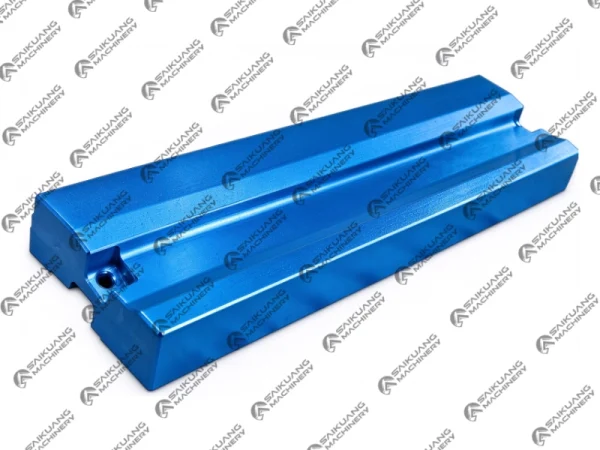
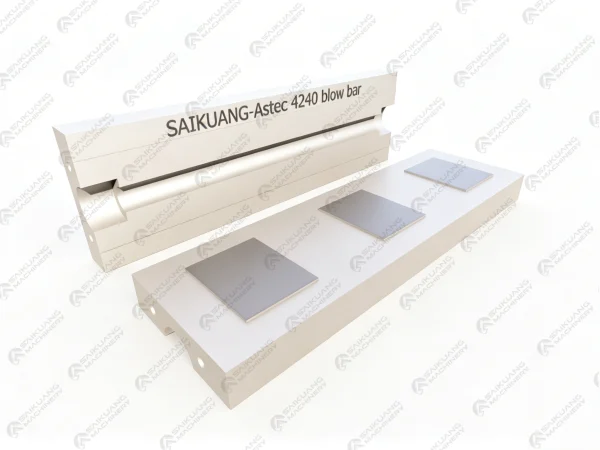
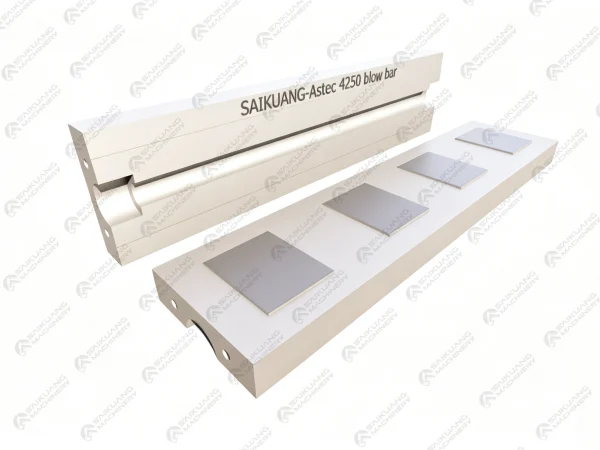
Tesab RK623 Blow Bars
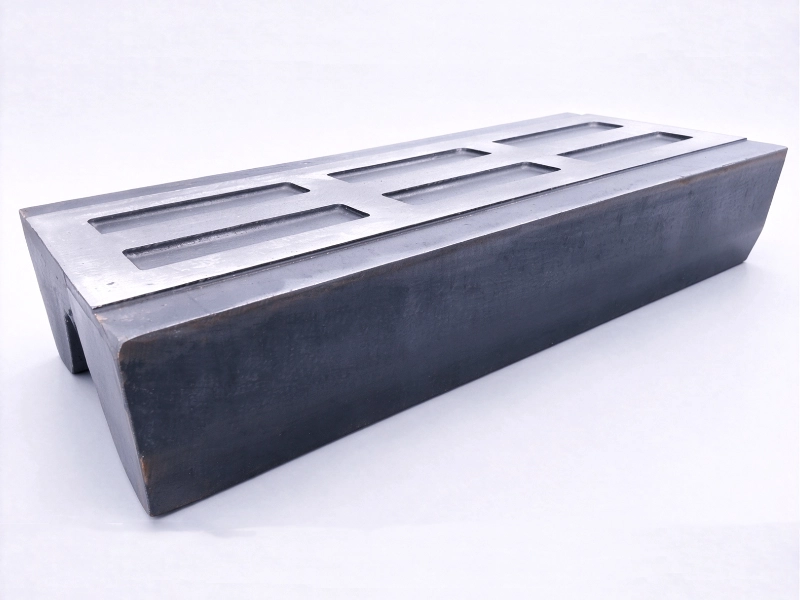
The Tesab RK623 Blow Bar is the primary impact wear component in the RK623 horizontal shaft impactor, a compact mobile unit built around a 1,100 mm (42”) diameter rotor. Unlike larger impactors that carry four or more blow bars per rotor, the RK623 operates with a three-bar set, and the replacement economics reflect that: a single worn bar changes the rotor’s balance and striking pattern, so blow bars for this machine are almost always procured and installed as a matched set of three.
The RK623’s three-bar rotor means each bar carries a proportionally higher share of the crushing load per revolution than a four-bar design. That makes material selection and wear-position management more consequential, not less: a bar that cracks or rounds off early takes one-third of the rotor’s striking capacity out of service, not one-fourth.
Material Options for Tesab RK623 Blow Bars
The correct grade for Tesab RK623 Blow Bars are determined by the dominant failure mode in the application. The RK623 is commonly used in concrete and asphalt recycling, quarrying, and contract crushing, and the feed profile varies accordingly.
| Material Code |
Description |
Wear Life |
Feed size |
Tramp Iron |
Typical Applications |
| 200S |
Manganese |
Short |
No limitation |
Allowed |
Concrete, asphalt slabs recycling, Natural stones etc |
| 200ST |
Manganese + TiC insert |
2x times 200S |
No limitation |
Allowed |
Concrete, asphalt slabs recycling, Natural stones etc |
| 550M |
Low chrome (Martensitic) |
Medium |
< 800 mm |
Allowed |
Concrete, asphalt slabs recycling, Natural stones etc |
| 550MC |
Low chrome (Martensitic)
w/ceramic |
2x times 550M |
< 800 mm |
Allowed |
Concrete, asphalt slabs recycling, Natural stones etc |
| 550MCT |
Reinforced
Low chrome ceramic |
1.5x times 550MC |
< 800 mm |
Allowed |
Concrete, asphalt slabs recycling, Natural stones etc |
| 550MYT |
Reinforced
Low chrome NewGen ceramic |
2x times 550MC |
< 800 mm |
Allowed |
Concrete, asphalt slabs recycling, Natural stones etc |
| 600C |
Medium chrome |
Long |
< 400 mm |
Not allowed |
Concrete recycling, Natural stones etc |
| 600CC |
Medium chrome ceramic |
2x times 600C |
< 400 mm |
Not allowed |
Concrete recycling, Natural stones etc |
| 600CCT |
Reinforced
Medium chrome ceramic |
1.5x times 600CC |
< 400 mm |
Not allowed |
Concrete recycling, Natural stones etc |
| 650C |
High chrome |
Long |
< 200 mm |
Not allowed |
Concrete recycling, Hard natural stones etc |
| 650CC |
High chrome ceramic |
2x times 650C |
< 200 mm |
Not allowed |
Concrete recycling, Hard natural stones etc |
| 700CCT |
Reinforced
High chrome |
1.5x times 650CC |
< 200 mm |
Not allowed |
Concrete recycling, Hard natural stones etc |
| 700CX |
Reinforced
High chrome ceramic |
2x times 650CC |
< 200 mm |
Not allowed |
Hard natural stones, Granites, Quartzes etc |
The hardness split is the practical decision point. High-chromium iron at 60–64 HRC delivers substantially longer wear life in abrasion-dominated duty, but its lower toughness makes it less forgiving of tramp metal and oversize feed. Martensitic steel at 48–54 HRC sacrifices peak hardness for impact resistance, and the ceramic-reinforced martensitic grades recover much of the wear-life gap without giving up that toughness. For an RK623 processing construction and demolition waste with unpredictable metal content, a martensitic or ceramic-martensitic grade is the technically defensible starting point. For a clean quarry feed with controlled top size and magnetic separation upstream, high-chromium iron is the appropriate selection.
Core Advantages of Saikuang Tesab RK623 Blow Bars
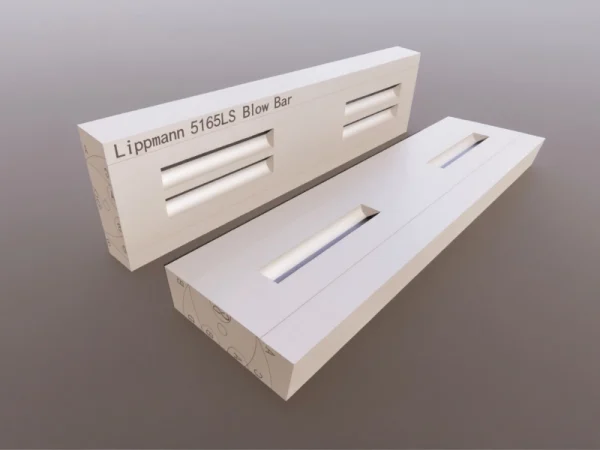
1. Dimensional Fit to the Three-Bar Rotor. Tesab RK623 Blow Bars are produced to the 103 kg / 610 × 264 × 123 mm reference envelope, with mounting interfaces designed to seat correctly in the RK623 rotor. Consistent mass distribution across a matched set of three is maintained so that installation does not introduce rotor imbalance before the bars have worn at all.
2. Full Material Range Under One Specification. Saikuang supplies RK623 blow bars in manganese, TiC-reinforced manganese, martensitic, ceramic-martensitic, and high-chromium iron. The material code is matched to the feed abrasiveness, top size, and tramp iron exposure of the specific machine, rather than defaulting to a single “standard” grade.
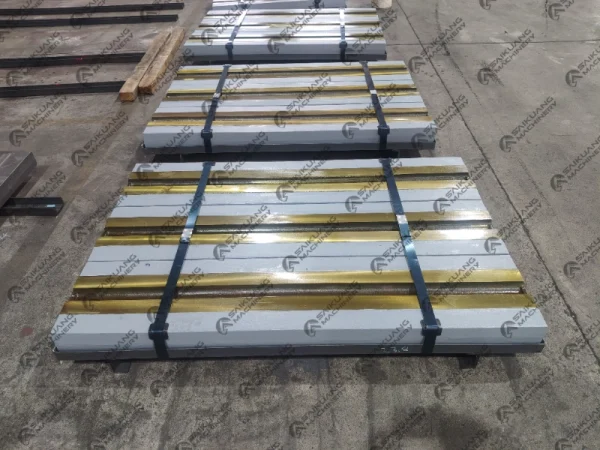
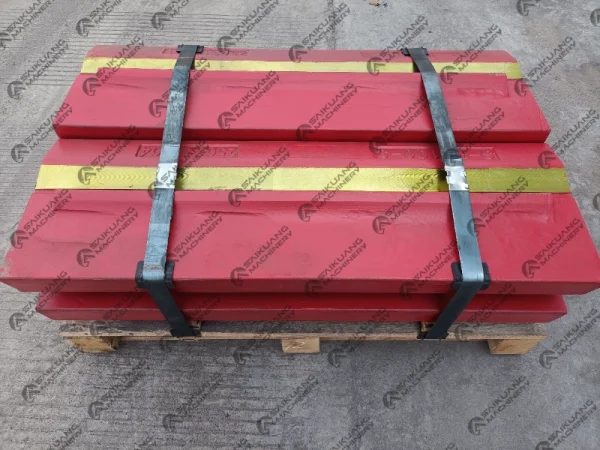
3. Matched-Set Supply. Because the RK623 runs a three-bar rotor, the practical unit of purchase is a matched set, not an individual bar. Saikuang supplies RK623 blow bars as balanced sets so that all three bars enter service with consistent mass and geometry, preserving rotor balance from the first hour of operation.
4. Full RK623 Wear-Part Coverage. Beyond the blow bar, the RK623 wear circuit includes the grinding list / grinding path (approximately 18.5 kg per piece under the 4-485 reference), apron liners, and side liners. Sourcing these against the same dimensional reference simplifies a complete chamber changeout and reduces the risk of mismatched fit between bar and impact plate.
When to Replace Tesab RK623 Blow Bars
The Tesab RK623 Blow Bar does not follow a fixed calendar interval. Replacement is triggered by the condition of the striking edge, the availability of fresh wear positions, and the rotor’s response to the worn set.
| Replacement Trigger |
Condition for Tesab RK623 Blow Bar |
| Striking edge rounding |
The exposed working face has developed an excessive radius; no defined striking reference remains on the current edge |
| Wear-position exhaustion |
All available wear edges on the three-bar set have been consumed; no fresh face remains for rotation |
| Cracking or chipping |
A crack extends into the working section, or a chip removes a significant portion of the striking face |
| Rotor response |
Noticeable vibration at operating speed, or throughput falling at unchanged apron settings and feed conditions |
| Matched-set integrity |
One or more bars have lost mass or geometry to the point that the set is no longer balanced as a three-bar group |
The three-bar configuration makes the matched-set trigger particularly important. Replacing a single worn bar in a three-bar rotor while two bars retain different remaining mass produces an imbalanced rotor that loads the bearings and accelerates wear on the “good” bars. The practical rule is that a Tesab RK623 blow bar changeout is a set decision: either all three bars are replaced, or the set is rotated together to expose fresh edges while preserving balance.
About Saikuang Casting
Saikuang Casting is a manufacturer of premium-quality crusher wear parts serving the mining, aggregate, and recycling industries. Our Tesab impactor range includes blow bars and grinding path components for the RK623/624 and RK1012, produced to OEM-equivalent dimensions and warrantied by Saikuang. To select the correct material grade for your Tesab RK623 Blow Bars, send us the feed material, top size, current bar life in hours or tons, and whether tramp metal is present in the feed; our team will match the alloy to the duty and provide a quotation for a matched three-bar set.
Email: infosk@skpremiumcasting.com
Tel: 0086-17351780508