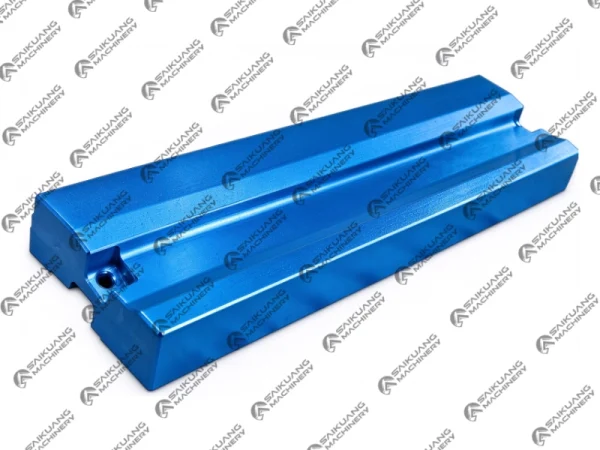
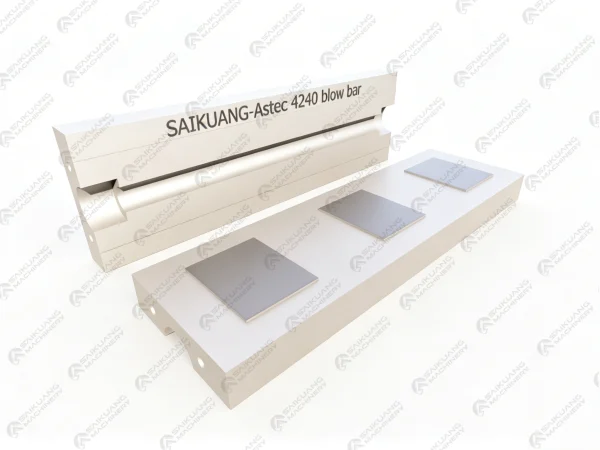
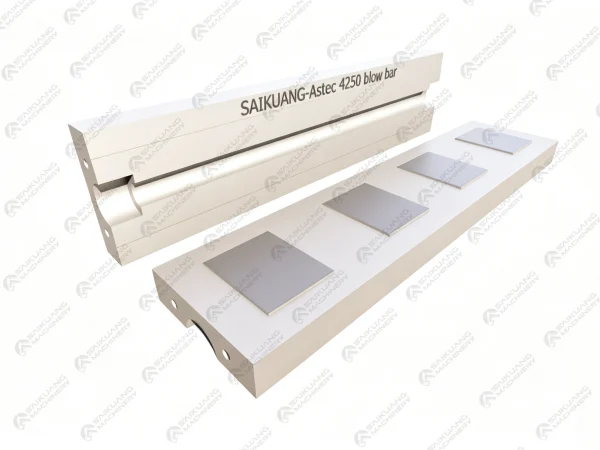
Lippmann 5165LS Blow Bar
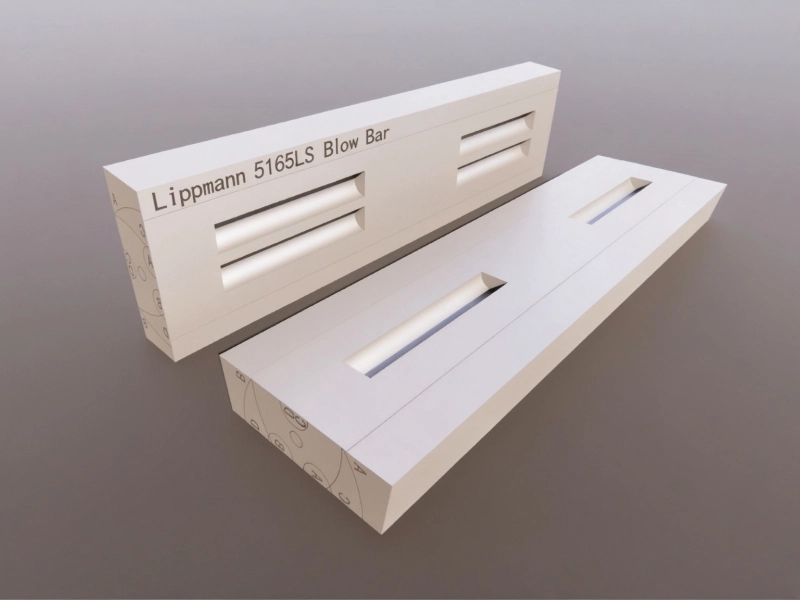
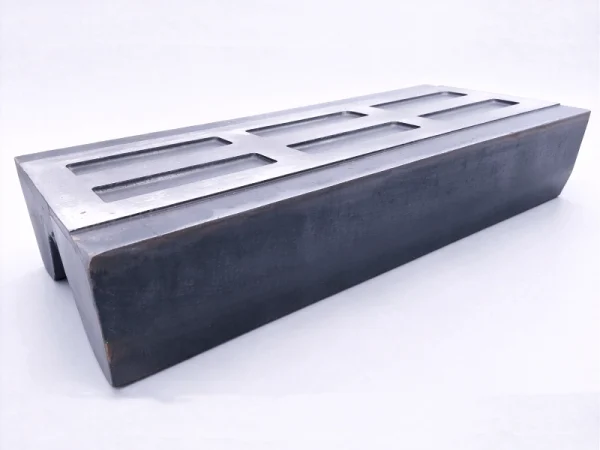
The Lippmann 5165LS Blow Bar is the primary impact wear component in the 5165LS horizontal shaft impactor, Lippmann’s secondary recycling and aggregate plant driven by a 300 kW (407 hp) motor. The 5165LS is built around a four-bar rotor, and each hammer position is designed with four wearable edges—meaning a single Lippmann 5165LS Blow Bar can be flipped and repositioned to expose fresh striking surfaces before it is finally consumed. That design intent matters for procurement: the blow bar is not simply a heavy steel slab that gets thrown away when the edge dulls. It is a component whose economic life is determined by how many of those wear positions are used, and by whether the alloy underneath the striking face can withstand the impact and abrasion profile of the specific feed.
Material Options for Lippmann 5165LS Blow Bar
The correct alloy for a Lippmann 5165LS Blow Bar is determined by the dominant wear mechanism in the application: high-stress impact, high-stress abrasion, or a combination of both. The 5165LS operates as a secondary unit, so feed is typically pre-sized, but that does not make material selection a secondary decision. A blow bar that is too brittle for the feed will crack before it wears; a blow bar that is too soft will round off its edges before it delivers useful service life.
| Material Code |
Description |
Wear Life Reference |
Feed / Tramp Iron Tolerance |
Typical Application |
| 200S |
Manganese steel |
Baseline (short) |
No feed-size limit; tramp iron allowed |
Concrete and asphalt slab recycling where impact severity is the controlling factor |
| 200ST |
Manganese + TiC insert |
2× 200S |
No feed-size limit; tramp iron allowed |
Recycling duty requiring improved wear life without sacrificing toughness |
| 550M |
Low-chrome martensitic |
Medium |
Feed < 800 mm; tramp iron allowed |
General aggregate and recycling duty with moderate abrasion |
| 550MC |
Low-chrome martensitic with ceramic |
2× 550M |
Feed < 800 mm; tramp iron allowed |
Abrasive aggregate feed where ceramic reinforcement extends edge retention |
| 550MCT |
Reinforced low-chrome ceramic |
1.5× 550MC |
Feed < 800 mm; tramp iron allowed |
High-abrasion secondary crushing where maximum ceramic content is beneficial |
| 550MYT |
Reinforced low-chrome NewGen ceramic |
2× 550MC |
Feed < 800 mm; tramp iron allowed |
Demanding abrasive duty requiring the longest ceramic-reinforced martensitic life |
The material table above follows the selection logic used across Lippmann impactor wear parts: manganese grades protect against impact-driven failure, while martensitic and ceramic-reinforced grades target abrasive edge loss. For the 5165LS specifically, the martensitic ceramic designation is the most frequently referenced material for this blow bar. In practical terms, a 550MC or 550MYT Lippmann 5165LS Blow Bar is the appropriate starting point for abrasive secondary feed, while a 200S or 200ST grade is the safer choice where tramp metal risk is high and cracking, rather than wear, is the dominant failure mode.
Core Advantages of Saikuang Lippmann 5165LS Blow Bar
1. Confirmed Dimensional Fit. The Lippmann 5165LS Blow Bar is produced to the 375 kg / 1,645 mm reference envelope, with mounting interfaces designed to seat correctly in the four-bar 5165LS rotor. Fit is guaranteed for crushers that have not been modified or rebuilt outside original dimensions.
2. Multiple Wear Positions Are Preserved. The 5165LS rotor design provides four wear positions per hammer position. A blow bar that is dimensionally accurate but poorly balanced across those positions will not deliver the intended utilization. Saikuang blow bars are produced with consistent mass distribution so that flipping and repositioning expose fresh edges without introducing rotor imbalance.
3. Application-Matched Alloy Selection. Saikuang supplies Lippmann 5165LS Blow Bars in manganese, TiC-reinforced manganese, martensitic, ceramic-martensitic, and reinforced ceramic grades. The selection is not left to guesswork: the material code is matched to the feed abrasiveness, feed size, and tramp iron exposure of the specific 5165LS installation.
4. Full 5165LS Wear-Part Coverage. Beyond the blow bar, Saikuang supplies apron liners, side liners, and impact plates for the 5165LS, allowing a complete wear-parts changeout to be sourced against a single dimensional reference. The 5165LS blow bar is listed alongside the 4248 (270 kg) and 5165LP (565 kg) in Saikuang’s Lippmann impactor range, so cross-model inventory planning is possible within one supplier relationship.
When to Replace the Lippmann 5165LS Blow Bar
The Lippmann 5165LS Blow Bar does not need to be replaced on a fixed calendar. Replacement is triggered by the condition of the striking edge, the remaining wear allowance, and the rotor’s response to the worn bar. The following condition-based triggers apply directly to the 5165LS.
| Replacement Trigger |
Condition for Lippmann 5165LS Blow Bar |
| Striking edge rounding |
The working face has developed an excessive radius, and no flat or defined striking reference remains on the currently exposed edge |
| Wear-position exhaustion |
All four available wear positions have been used; no fresh edge remains for flipping or repositioning |
| Cracking or chipping |
A crack extends into the working section, or a chip removes a significant portion of the striking face |
| Mass loss and rotor response |
Individual bar mass loss has produced noticeable rotor vibration, or throughput has fallen at unchanged apron settings and feed conditions |
| Fit or mounting condition |
The bar no longer seats correctly, or mounting hardware cannot maintain the bar securely under load |
The four-position design means that the first replacement decision is usually a rotation decision, not a discard decision. When the exposed edge rounds off, the bar is flipped or repositioned to bring a fresh edge into the striking path. Replacement becomes due when the available wear positions have been consumed, or when cracking or mass loss moves the bar outside its functional envelope before the wear positions are exhausted. A bar that has been run to the point of rotor vibration has already transferred unnecessary load to the bearings and shaft; the economic trigger is the vibration and throughput response, not the remaining steel thickness.
Other Lippmann Impactor Wear Parts Available from Saikuang
About Saikuang Casting
Saikuang Casting is a manufacturer of premium-quality crusher wear parts serving the mining, aggregate, and recycling industries. Our Lippmann impactor range includes blow bars, impact plates, and side liners for the 4248, 5165LS, and 5165LP models, produced to OEM-equivalent dimensions and warrantied by Saikuang. To select the correct material grade for your Lippmann 5165LS Blow Bar, send us the feed material, feed size, current bar life, and any tramp iron conditions; our team will match the alloy to the duty and provide a quotation.
Email: infosk@skpremiumcasting.com
Tel: 0086-17351780508