
For over a century, one specific alloy has dominated the heavy-duty mining and aggregate industries. Despite massive advancements in modern metallurgy, this classic formulation remains the undisputed king for high-impact applications. But what makes this metal so special?
The secret lies in a fascinating microscopic transformation that occurs only when the metal is subjected to severe punishment. This article explores the science, history, and application of the most critical alloy in the crushing industry.
The Discovery of Hadfield Steel
In 1882, a British metallurgist named Sir Robert Hadfield made a groundbreaking discovery. He found that by adding a specific, high percentage of manganese to carbon steel, he created an alloy with properties previously thought impossible.
Standard steel becomes brittle when made very hard, or soft when made very tough. Hadfield’s invention—often referred to simply as Manganese steel—broke this rule. In its initial state, the metal is relatively soft and incredibly tough, able to absorb massive shocks without shattering. However, its true magic reveals itself upon impact.
The Science of Work-Hardening
The defining characteristic of this alloy is its ability to undergo work-hardening (also known as strain hardening).
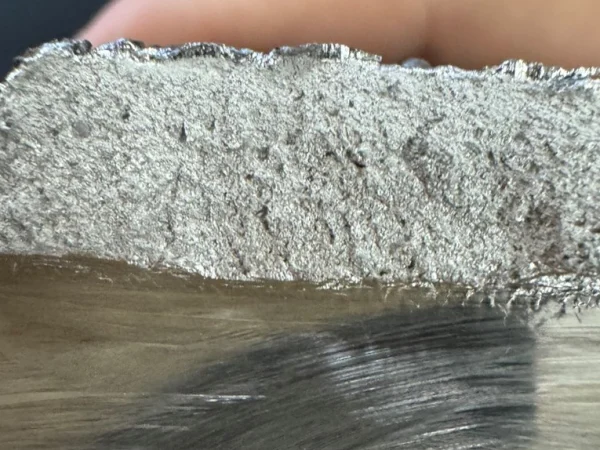
When the surface of the steel is subjected to repeated, heavy impacts (like a boulder smashing against a jaw plate), the crystalline structure of the metal physically changes. The impact forces cause the grains on the outer layer of the steel to compress and deform, transitioning from a relatively soft austenitic structure into an incredibly hard martensitic structure.
Why is this beneficial?
- Hard Exterior: The outer layer facing the rock becomes extremely hard (often jumping from ~200 BHN to over 500 BHN), providing excellent resistance to sliding abrasion.
- Tough Interior: While the outer skin hardens, the core of the casting remains soft, ductile, and impact-resistant.
- Self-Renewing: As the hard outer layer eventually wears away, the newly exposed soft layer immediately undergoes the exact same hardening process. It is a continuously regenerating shield.
Chemical Composition and Grades
The standard composition typically involves 11% to 14% Mn, coupled with roughly 1% to 1.4% Carbon. However, modern foundries have evolved the formula to suit specific applications.
| Grade Designation | Manganese Content | Typical Additives | Ideal Application Profile |
|---|---|---|---|
| Standard (Mn14) | 11% – 14% | None | Standard jaw and cone crushing; good all-rounder. |
| Medium (Mn18) | 16% – 19% | Chromium (1-2%) | Highly abrasive, high-impact ores; longer life than Mn14. |
| High (Mn22) | 21% – 24% | Chromium, Molybdenum | Extreme applications; requires massive impact to harden properly. |
Note: Adding Chromium to the mix helps increase the initial yield strength and provides a slight bump in baseline abrasion resistance.
The “Insufficient Impact” Problem
While it sounds like a miracle metal, there is a critical caveat to its application. The work-hardening process requires severe impact to trigger the transformation.
If you use this austenitic steel in an application with high sliding abrasion but very low impact (for example, crushing soft, sandy gravel in a tertiary cone crusher), the metal surface will never harden. Instead, the abrasive material will simply gouge away the soft steel, leading to an incredibly short wear life. In these specific scenarios, operators must switch to high-chrome or martensitic alloys.
Heat Treatment: The Crucial Final Step
The chemical composition is only half the battle. When this steel is first cast in the foundry, it is extremely brittle due to the presence of carbide structures along the grain boundaries.
To achieve its legendary toughness, the casting must undergo a strict water-quenching heat treatment process. The metal is heated to over 1000°C (dissolving the carbides) and then rapidly plunged into cool water. This “freezes” the internal structure in its tough, austenitic state. A poorly heat-treated casting will fail catastrophically in the field, highlighting the importance of sourcing from reputable manufacturers.
Conclusion
The enduring legacy of Manganese steel in the aggregate and mining sectors is a testament to its unique metallurgical properties. By essentially “fighting back” against the forces of impact through continuous surface hardening, it provides a balance of safety (non-shattering core) and longevity (hardened skin) that remains unmatched for primary crushing applications. Understanding how this metal reacts to your specific rock is key to optimizing your plant’s performance.
 |
 |
FAQ
Q1: Why can’t I machine or drill into my new cone mantle easily?
A: Even the act of machining or drilling applies mechanical stress to the metal, causing it to harden instantly under the cutting tool. This makes it notoriously difficult to machine. Foundries typically use specialized ceramic inserts or cast the mounting holes directly into the part.
Q2: Will a higher grade (like Mn22) always last longer than Mn14?
A: Not necessarily. Mn22 requires significantly more kinetic energy (harder rocks, bigger crushers) to trigger its hardening properties. If the impact forces in your chamber are too low, Mn22 will wear out faster than Mn14 because it won’t harden effectively.
Q3: Can these parts be recycled after they are fully worn?
A: Yes, absolutely. Worn liners are highly sought after as premium scrap. Foundries melt them down, adjust the chemistry, and cast them into brand new components, making it a highly sustainable material cycle.