
Introduction
Shredder hammers are the key wear parts for metal scrap shredders. They face strong impact and heavy wear every day during scrap recycling. Good shredder hammers can reduce machine downtime and cut your total operation cost.
Many recycling plant managers and purchasing teams look for reliable global suppliers . This guide lists 8 well-known international suppliers of shredder hammers. We collect information based on market share, technical strength, global service network and real customer feedback.
1. ESCO Corporation (USA)
- Main Products: DynaForce series hammers, DHT differentiated hardening shredder hammers, pin-type curve hammers
- Core Advantages: Manganese steel base with special hardening treatment. Strong compatibility with Newell, Williams heavy scrap shredders. Complete global after-sales network.
- Suitable Working Conditions: Heavy scrap, car body shells and mixed tough waste shredding.
2. Magotteaux (Belgium)
- Main Products: Xwin® composite shredder hammers, high chromium alloy hammers (MMC metal matrix composite)
- Core Advantages: Ceramic composite wear layer. Good balance between impact toughness and wear resistance. It can provide complete crushing condition optimization plans.
- Suitable Working Conditions: Scrap metal, construction waste and non-ferrous metal shredding. Fit Lindemann and Terex shredder machines.
3. Lindemann GmbH (Germany)
- Main Products: Original standard shredder hammers for Lindemann full series shredders
- Core Advantages: Perfect size and structure matching Lindemann shredders. High precision of original spare parts.
- Suitable Working Conditions: Factories equipped with Lindemann large scrap metal shredders.
- Reminder: Original Lindemann hammers usually carry higher prices. Many buyers select SWB and ESCO as cost-saving alternatives.
4. WENDT Castings (USA)
- Main Products: Heavy-duty one-piece shredder hammers, rebuildable hammers for overlay welding
- Core Advantages: Fast local delivery in North America. Engineers can provide on-site technical support for wear problems.
- Suitable Working Conditions: Medium and small scrap recycling companies across the United States.
5. Stahlwerke Bochum (SWB, Germany)
- Main Products: Standard DHT series shredder hammers
- Core Advantages: Low risk of hammer cracking and breaking. Adopt German forging and precise heat treatment. Many Lindemann shredder users choose SWB as original alternative parts.
- Suitable Working Conditions: Large recycling factories in Europe with continuous heavy-load production.
6. K2 Castings (Australia)
- Main Products: Manganese steel shredder hammers, high chromium composite hammers, ring hammers
- Core Advantages: Products optimized for mixed ore and scrap crushing. Strong ability to make customized sizes.
- Suitable Working Conditions: Small and medium scrap shredders, mobile crushing equipment.
7. FAMUR Group (Poland)
- Main Products: High chromium cast iron shredder hammers, bimetallic composite shredder hammers
- Core Advantages: Balanced price between high-end European brands and Asian manufacturers. Convenient transportation for European buyers.
- Suitable Working Conditions: Light scrap metal, construction waste and non-ferrous material crushing.
8. Bradken (Australia)
- Main Products: Bimetallic composite shredder hammers, pre-hardfaced wear hammers
- Core Advantages: Multiple production bases around the world. Stable supply for international recycling projects.
- Suitable Working Conditions: Overseas factories of global resource recycling enterprises.
About Saikuang’s Shredder Hammers
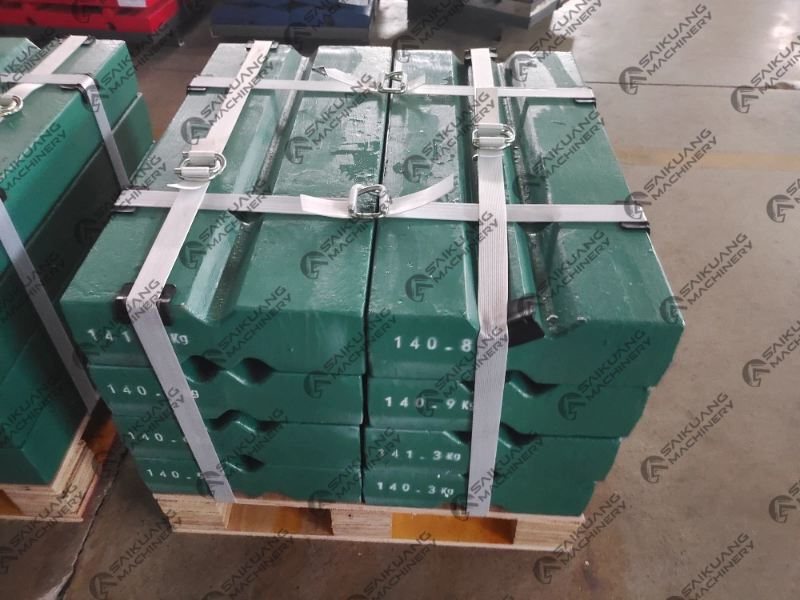
Shredders are widely used in metal scrap recycling. The Shredder device includes hammers joined to a massive rotor. Hammers are responsible for grinding and play a vital role in the shredder. Most of the casted hammers are made from austenitic manganese steel.
Combined with rigorous lean manufacturing processes at our foundries, Saikuang Casting has brought to the market a shredder hammer line that provides our customers with the lowest cost per ton. Our Shredder hammers are made in proprietary manganese steel, alloy steel, and TIC Inserts hammers. We also make different materials to suit different work conditions, which are extremely hard on the bottom and possess a softer material around the pin to keep the pin from wearing out. In essence, we can right-size the metallurgy of the casting to the particular application, resulting in the most wear-resistant part available.
Five Main Types of Saikuang Shredder & Crusher Hammers
Saikuang supplies five mainstream hammer types for metal shredding and stone crushing, covering entry-level, general-purpose, high-wear, dual-hardness and ultra-heavy-duty grades. Each material features unique hardness, toughness and wear performance, matching light to extreme heavy working conditions. The below table simplifies core features, advantages, limitations and applicable scenarios for quick selection.
1. DHT Dual-Hardness Alloy Steel Hammers
What it is: DHT stands for Double Hardness Technology. This is one of the most important — and most misunderstood — innovations in crusher hammer metallurgy.
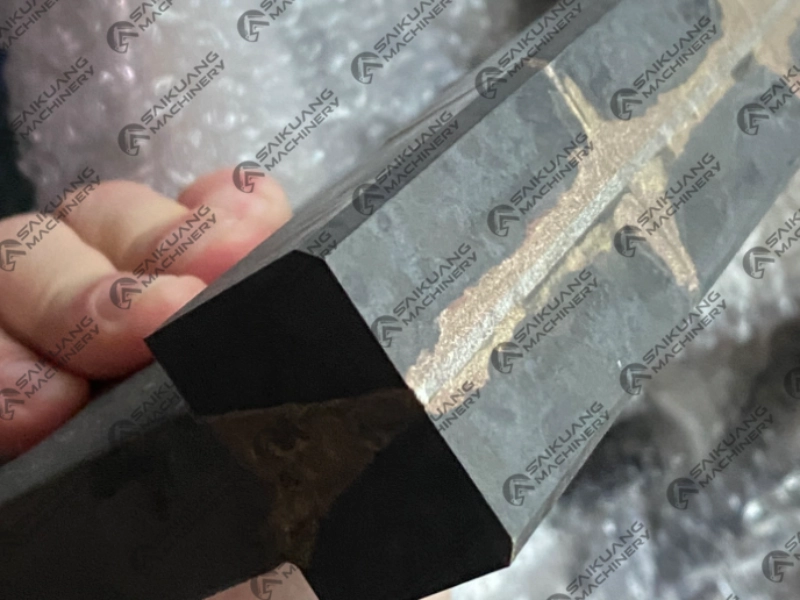
DHT hammers use a single-alloy casting with two independently heat-treated zones — rather than bonding or inserting two separate materials together. The result: no interfaces, no delamination risk, no inserts to come loose under impact.
The dual-hardness effect is achieved through two independent heat treatment cycles applied to different zones of the same casting:
| Zone | Hardness Target | Property Focus |
| Hammer shank (body) | Lower hardness (38–45 HRC) | High toughness, impact absorption |
| Hammer face (striking surface) | Higher hardness (55–58 HRC) | Maximum wear resistance |
Key advantages:
- No delamination or insert separation— zone-differentiated heat treatment within one casting, not two bonded materials
- Longer service life— in documented heavy auto shredding applications, Saikuang Casting customers have reported 3–4× the wear life of standard Mn13 hammers under comparable operating conditions
- Suitable for the highest-stress operating conditions
2. Single-Hardness Alloy Steel Hammers
Made of premium chromium-molybdenum-nickel alloy steel, single-hardness alloy steel hammers undergo integral uniform heat treatment, delivering a consistent full-body hardness of 48–58 HRC. The uniform hardness ensures even wear during operation, maintaining stable rotor balance and enabling predictable maintenance cycles. It excels in high-abrasion and medium-impact environments, ideal for limestone crushing, mineral processing and scrap mixed with slag and impurities.
Its biggest limitation is relatively poor impact toughness. When facing sudden ultra-high impact, high-hardness alloy steel is prone to cracking. It is the best choice for working conditions where abrasion wear dominates over strong impact force.
3. High Manganese Steel Hammers
High manganese steel (Hadfield steel) is available in Mn13, Mn18 and Mn22 grades. Adopting professional water toughening treatment, it forms a stable austenitic internal structure. This hammer features excellent overall toughness and strong crack resistance, with a typical self-work-hardening function. Its surface hardness gradually rises from about 200 HB to over 500 HB under continuous impact.As a cost-effective and reliable basic-grade material, it is widely used for light to medium shredding work.
It performs well when processing thin sheet metal, light scrap and waste household appliances, and perfectly matches small shredders of 400–600 HP. The main drawback is unstable wear resistance in low-impact or pure abrasive working conditions, where the self-hardening effect cannot be fully activated, leading to faster wear.
4. Modified High Manganese Steel Hammers
Modified high manganese steel is the mainstream material for modern scrap shredding. Based on standard Mn13 or Mn18 steel, Saikuang adds targeted alloy elements including chromium, molybdenum, vanadium and titanium to form reinforced carbide structures inside the steel. It completely retains the outstanding toughness and impact resistance of traditional manganese steel, while boosting wear resistance by 30%–100%. This material achieves an optimal balance of safety, service life and cost, avoiding sudden fracture risks.
It is suitable for medium to heavy shredding scenarios such as waste car bodies, steel rebars, thick scrap plates and mixed materials, adapting to general shredders of 600–2000 HP. It is the preferred universal option for most scrap yards, cement plants and mineral processing sites.
5. Forged Alloy Steel Hammers
Forged alloy steel hammers are ultra-heavy-duty accessories for extreme working conditions. Produced from solid chromium-molybdenum-nickel alloy steel billets through high-pressure integral forging, the material forms a dense and orderly grain structure, eliminating all casting defects. With a hardness range of 45–55 HRC (up to 60 HRC after surface strengthening), it features superior tensile strength, fatigue resistance and crack resistance under cyclic heavy impact. It is mainly applied to 3000+ HP super-large shredders, processing heavy structural steel, demolition scrap and large castings.
It can effectively resist impact from uncrushable materials and prevent secondary damage to rotors and equipment. Though it has the highest cost among all hammer types, its ultra-long service life lowers the comprehensive tonnage processing cost for extreme-duty scenarios.
The Unique Advantages of Saikuang Casting
DHT Technology: Combines alloy steel’s hardness with manganese’s self-hardening.
Custom Solutions: Tailor hammer chemistry (e.g., +2% Cr for e-waste).
Global Reach: 15+ years serving clients in 30+ countries.
Choosing the right shredder hammer hinges on scrap type, hammer weight, and operational demands. Manganese steel excels for heavy, high-impact scrap, alloy steel dominates abrasive environments, and forged hammers tackle oversized materials.
At Saikuang Casting, we engineer hammers that outlast the competition. Whether you need high-carbon alloy hammers for e-waste or Mo-enhanced manganese hammers for mining, we’ve got you covered.
Your Reliable Partner for Crusher Spare Parts
Email: infosk@skpremiumcasting.com
Tel: 0086-17351780508