
When it comes to crushing hard rock in impact crushers, selecting the right wear parts is critical for maintaining efficiency, reducing downtime, and optimizing operational costs. Among the most crucial components in a horizontal shaft impactor (HSI) are the blow bars. These heavy-duty components bear the brunt of the impact as rocks enter the crushing chamber. For operators tackling tough, abrasive materials, the debate often centers on two primary materials: ceramic and high chrome.
This comprehensive guide will explore the intricacies of “Ceramic vs. High Chrome Blow Bars,” dissecting their properties, performance in specific applications, and ultimately helping you determine which is the superior choice for your hard rock crushing needs. We will examine the unique wear characteristics, cost implications, and operational benefits of each to provide a clear path to maximizing your crusher’s performance.
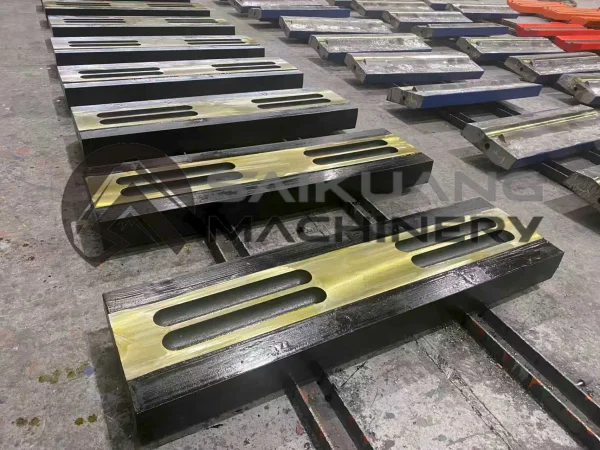
Understanding the Challenges of Hard Rock Crushing
Before diving into the specific blow bar materials, it’s essential to understand the environment they operate in. Crushing hard rock, such as granite, basalt, or quartzite, presents unique challenges:
- High Abrasion: Hard rocks are typically highly abrasive. As they slide against the blow bars during the crushing process, they act like sandpaper, rapidly wearing down the surface metal.
- High Impact Forces: The initial impact when the rock meets the spinning rotor generates immense force. The blow bar must be tough enough to withstand these repeated shocks without shattering or snapping.
- Variable Feed Size: In many quarrying operations, the feed size can fluctuate, leading to uneven wear patterns and unpredictable stress on the crusher components.
The ideal blow bar for hard rock must possess a delicate balance between hardness (to resist abrasion) and toughness (to resist impact). Finding this balance is the key to minimizing wear and maximizing throughput.
High Chrome Blow Bars: The Traditional Workhorse
High chrome white iron has long been the industry standard for impact crusher blow bars, especially in applications involving highly abrasive materials.
Composition and Properties
High chrome blow bars are characterized by a microstructure consisting of hard chromium carbides supported by a tough martensitic or austenitic matrix. The chromium content typically ranges from 15% to 30%, depending on the specific alloy grade.
- Hardness: High chrome iron exhibits exceptional hardness, often reaching 60-65 HRC (Rockwell Hardness Scale C). This high hardness provides excellent resistance to the abrasive wear caused by sliding friction against hard rock.
- Toughness: While hard, high chrome is inherently brittle compared to materials like manganese steel. It is susceptible to catastrophic failure (breakage) if subjected to excessive impact forces or tramp metal (un-crushable objects like excavator teeth).
Performance in Hard Rock
In hard rock applications where abrasion is the primary wear mechanism and the feed size is relatively controlled, high chrome blow bars excel. They can maintain their profile for extended periods, ensuring consistent product gradation and high crushing efficiency.
However, their susceptibility to breakage makes them less suitable for primary crushing applications where the feed material contains large boulders or if there’s a high risk of tramp metal entering the chamber. They are generally preferred for secondary or tertiary crushing stages where the rock size is smaller and more uniform.
| Feature | High Chrome Blow Bars |
|---|---|
| Primary Advantage | Excellent abrasion resistance |
| Primary Disadvantage | Susceptible to breakage from high impact/tramp metal |
| Best Application | Secondary/Tertiary crushing, highly abrasive, controlled feed size |
| Cost | Generally lower initial cost than ceramic inserts |
Ceramic Blow Bars: The Innovative Challenger
To address the limitations of high chrome in high-impact applications while maintaining exceptional wear resistance, the industry developed a hybrid solution: ceramic-inserted blow bars.
Composition and Design
Ceramic blow bars are not made entirely of ceramic. They are a composite material consisting of a tough metallic matrix (often martensitic steel or high chrome iron) with strategically placed ceramic inserts on the wearing face.
- The Matrix: The base metal provides the necessary toughness to absorb the impact forces without shattering. Martensitic steel is often chosen for primary crushing due to its superior impact resistance, while high chrome might be used as the matrix in secondary applications for an extra boost in wear life.
- The Ceramic Inserts: The inserts are typically made from advanced ceramics like zirconia-toughened alumina (ZTA). These ceramics are incredibly hard (much harder than high chrome) and possess excellent wear resistance.
The Synergistic Effect
The genius of the ceramic blow bar design lies in the synergy between the two materials. The hard ceramic inserts protrude slightly from the metallic matrix, taking the brunt of the abrasive wear. As the rock slides over the surface, the ceramic protects the softer matrix beneath. Meanwhile, the tough metallic matrix absorbs the impact energy, preventing the brittle ceramic inserts from shattering.
Performance in Hard Rock
In hard rock crushing, particularly where both high abrasion and high impact are present, ceramic blow bars often outperform standard high chrome bars significantly.
- Extended Wear Life: The ceramic inserts drastically reduce the wear rate on the leading edge of the blow bar. It is not uncommon for ceramic-inserted bars to outlast standard high chrome bars by a factor of 2 to 4 in severe applications.
- Maintained Profile: Because they wear so slowly, ceramic blow bars maintain their original profile longer. This consistent shape ensures optimal crushing efficiency and product gradation throughout the life of the bar, reducing the need for frequent gap adjustments.
- Increased Versatility: The combination of toughness (from the matrix) and hardness (from the inserts) makes them suitable for a wider range of applications, including primary crushing of abrasive rock where standard high chrome might fail.
| Feature | Ceramic Blow Bars |
|---|---|
| Primary Advantage | Exceptional wear life, combines toughness and hardness |
| Primary Disadvantage | Higher initial cost |
| Best Application | Primary/Secondary crushing, highly abrasive, high impact, mixed feed |
| Cost | Higher initial investment, but often lower cost-per-ton |
Ceramic vs. High Chrome: A Detailed Comparison
To truly understand which blow bar is better for your hard rock application, we must compare them across several key operational metrics.
1. Wear Resistance and Lifespan
When evaluating “Ceramic vs. High Chrome Blow Bars,” the most prominent difference is wear life. While high chrome offers excellent abrasion resistance compared to manganese steel, it cannot compete with the sheer hardness of ceramic inserts.
In highly abrasive hard rock like quartzite or granite, high chrome bars will inevitably lose their profile as the abrasive particles scour the surface. Ceramic blow bars, on the other hand, hold their edge significantly longer. The ceramic inserts act as a shield, drastically slowing down the wear process. This extended lifespan translates directly to fewer change-outs, reduced downtime, and increased overall production.
2. Impact Resistance and Reliability
Hard rock crushing is not just about abrasion; it involves tremendous impact forces. This is where the brittleness of high chrome becomes a liability. If a particularly large, hard boulder or a piece of tramp metal enters the crusher, a high chrome blow bar can snap. This catastrophic failure not only halts production but can also cause severe damage to the crusher rotor and housing.
Ceramic blow bars mitigate this risk. By embedding the brittle ceramic in a tough metallic matrix (like martensitic steel), the bar can absorb significant impact energy without breaking. The matrix flexes and absorbs the shock, protecting the ceramic inserts. This makes ceramic bars a much safer and more reliable choice in primary crushing applications or where the feed material is inconsistent.
3. Efficiency and Product Quality
The shape of the blow bar directly affects the crushing efficiency and the shape of the final product. As a high chrome bar wears and loses its sharp edge, the crushing action becomes less efficient. The rocks are less effectively shattered on impact, leading to a higher percentage of oversized material and an increase in recirculating loads. The final product shape can also degrade, becoming less cubical.
Because ceramic blow bars maintain their profile much longer, they ensure a consistent, aggressive crushing action throughout their lifespan. This consistent performance results in a higher percentage of correctly sized product, fewer recirculating loads, and better overall product shape—crucial factors in aggregate production.
4. Total Cost of Ownership (TCO)
The initial purchase price of high chrome blow bars is generally lower than that of ceramic-inserted bars. This lower upfront cost makes them an attractive option for operations with tight budgets or in less severe applications.
However, true cost must be evaluated on a “cost-per-ton” basis over the long term. While ceramic blow bars require a larger initial investment, their extended wear life often results in a significantly lower overall cost.
Consider the hidden costs of using a cheaper, faster-wearing blow bar:
- Increased Downtime: Every time blow bars are changed, production stops.
- Labor Costs: Changing blow bars is a labor-intensive process.
- Maintenance Wear: Frequent changes increase wear and tear on crusher access points and rotor hardware.
- Decreased Efficiency: Worn blow bars consume more energy to crush less rock.
When factoring in the extended lifespan, reduced downtime, and maintained efficiency, the Total Cost of Ownership for ceramic blow bars in hard rock applications is frequently lower than that of standard high chrome.
Summary Comparison Table
| Metric | High Chrome Blow Bars | Ceramic Blow Bars |
|---|---|---|
| Abrasion Resistance | High | Very High (Due to ceramic inserts) |
| Impact Resistance | Low to Moderate (Brittle) | High (Tough metallic matrix) |
| Wear Life (Hard Rock) | Standard | Extended (Often 2x – 4x longer) |
| Profile Maintenance | Wears relatively quickly | Maintains sharp edge longer |
| Crushing Efficiency | Decreases as bar wears | Consistent throughout lifespan |
| Risk of Breakage | Higher (especially with tramp metal) | Lower |
| Initial Purchase Price | Lower | Higher |
| Total Cost per Ton | Can be higher due to frequent changes | Often lower in severe applications |
Making the Right Choice for Your Operation
The decision between ceramic and high chrome blow bars should not be based on initial price alone, but rather on a thorough analysis of your specific crushing environment.
When to Choose High Chrome Blow Bars:
- Secondary or Tertiary Crushing: In later crushing stages where the feed size is smaller (e.g., under 150mm) and more uniform, the impact forces are significantly reduced. High chrome’s excellent abrasion resistance can shine here without the high risk of breakage.
- Predictable Feed Material: If your feed material is consistently free of large boulders and tramp metal, the brittle nature of high chrome is less of a concern.
- Budget Constraints: If immediate capital expenditure is tightly constrained, high chrome provides a lower entry point, provided the application isn’t severe enough to cause rapid failure.
- Less Abrasive Materials: While we are focusing on hard rock, if you occasionally process less abrasive materials (like softer limestone), high chrome may provide adequate wear life.
When to Choose Ceramic Blow Bars:
- Primary Crushing: The tough metallic matrix of ceramic bars makes them ideal for absorbing the massive impact forces generated when primary crushing large, hard rock.
- Highly Abrasive Hard Rock: In materials like granite, basalt, or quartzite, the superior wear resistance of the ceramic inserts is essential for maintaining acceptable operational costs and minimizing downtime.
- Inconsistent Feed or Tramp Metal Risk: If your feed size fluctuates or there is a risk of un-crushable objects entering the chamber, the added toughness of the ceramic bar’s matrix is crucial insurance against catastrophic failure.
- Focus on Long-Term Efficiency: If your goal is to minimize cost-per-ton, maximize uptime, and ensure consistent product quality, ceramic blow bars are often the superior long-term investment.
Conclusion
The debate of “Ceramic vs. High Chrome Blow Bars” ultimately comes down to matching the material properties to the specific demands of the crushing application. High chrome remains a viable and cost-effective option for secondary crushing of abrasive materials where impact forces are controlled.
However, for the demanding conditions of hard rock primary crushing, or in severe secondary applications involving highly abrasive materials like granite or quartzite, ceramic blow bars are clearly the superior choice. The innovative design, combining a tough, impact-absorbing matrix with ultra-hard, wear-resistant ceramic inserts, addresses the fundamental challenges of hard rock crushing.
While the initial investment is higher, the extended wear life, improved reliability, reduced downtime, and consistent crushing efficiency consistently translate to a lower cost-per-ton and a more profitable operation overall. By carefully evaluating your feed material, crusher type, and long-term production goals, you can make an informed decision and select the blow bar that will optimize your hard rock crushing process.
FAQs
1. Can I use ceramic blow bars in an older impact crusher designed for high chrome?
In most cases, yes. Ceramic blow bars are typically designed as direct replacements for standard high chrome or manganese bars and match the original equipment manufacturer (OEM) specifications for size and weight. However, it is always recommended to consult with your wear parts supplier or crusher manufacturer to ensure compatibility, especially regarding rotor balance. Because ceramic bars may have a slightly different weight distribution, checking the rotor balance after installation is crucial.
2. Are ceramic blow bars more difficult to install than high chrome bars?
No, the installation process is identical. They fit into the rotor exactly the same way as standard metallic blow bars. The only difference is the care required during handling. While the metallic matrix is tough, the ceramic inserts themselves can be brittle if struck directly with a hard object (like a steel hammer during installation). Care should be taken not to chip the inserts during the handling and positioning process.
3. How do I know when a ceramic blow bar needs to be replaced?
The wear criteria for ceramic blow bars are similar to standard bars. They should be replaced when they have worn down to the point where crushing efficiency drops significantly, or before the wear reaches the rotor body, which could cause expensive damage. With ceramic bars, you will notice the metallic matrix wearing away around the inserts, but the bar will continue to function effectively as long as the inserts are intact and providing a crushing edge. Your wear parts supplier can provide specific wear limits based on the bar design and your crusher model.