
The Sandvik CJ412 Jaw Crusher
Sandvik is a Swedish engineering group whose rock processing division supplies crushing and screening equipment to aggregates and mining operations worldwide. The CJ412 is a single-toggle jaw crusher in Sandvik’s CJ Series, built for primary crushing in high-production stationary and mobile installations.
The platform is also sold under the older designation JM1208, and parts listings commonly cross-reference both model numbers. That matters for procurement: a Sandvik CJ412 support bar drawing number may also appear under JM1208 in supplier catalogs, and the two designations point to the same chamber hardware.
What the Sandvik CJ412 Support Bar 400.0309-001 Does
Position in the clamping system
In a jaw crusher, the jaw plate sits on the jaw face and must be prevented from lifting, sliding, or rocking under the cyclic crushing load. The CJ412 achieves this with clamping and support bars that fix the jaw plates to the crusher. The support bar bears against the plate edge or seating surface, and the wedge bears against the support bar. When the wedge is driven in, the clamping force is transmitted through the support bar into the jaw plate.
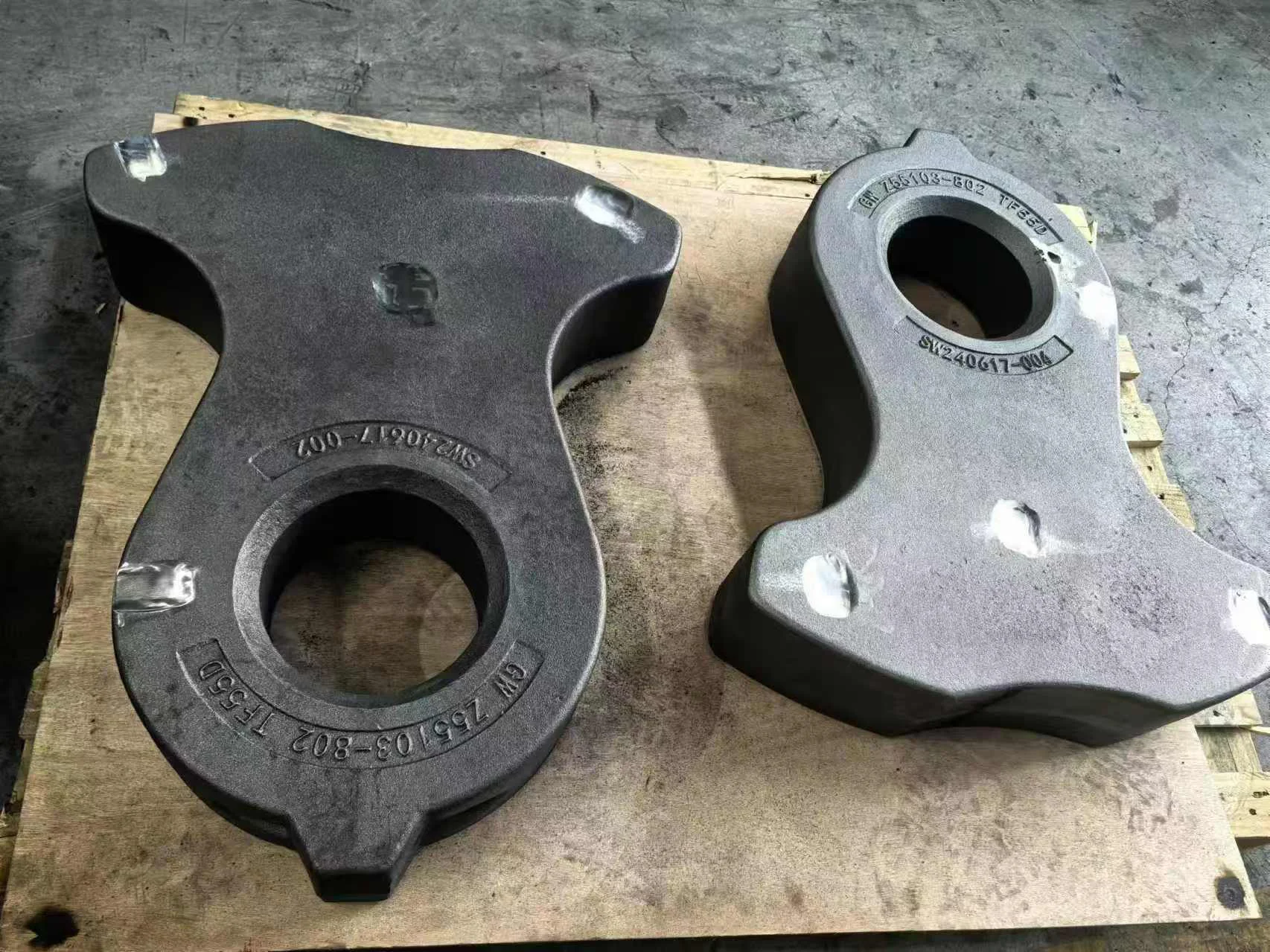
The part number 400.0309-001 appears in CJ412/JM1208 parts databases as a stationary support bar (опорный стержень, стационарный), with a corresponding moving support bar listed under the same number family. Aftermarket catalogs describe the same item as a support strip / double slot configuration for the CJ41 series. The “double slot” description indicates the bar is not a simple rectangular block; it has locating features that interface with the clamping arrangement.
Why it fails, and what failure looks like
The support bar is not a high-wear consumable in the same sense as a jaw plate. It does not see direct rock impact. Its failure modes are mechanical and tribological:
-
Deformation and brinelling at the wedge contact face, caused by repeated high-point loading when the wedge is set and re-set.
-
Slot wear where the clamping hardware bears, which reduces the effective clamping travel.
-
Fatigue cracking in the bar body if the part is under-specified for the clamping force or if the seating surfaces are not flat.
The symptom a plant notices first is usually jaw plate movement—a plate that will not stay seated, a change in product size that cannot be adjusted out with CSS, or abnormal noise from the chamber. By the time that symptom appears, the support bar and the wedge contact faces are usually both worn, and replacing the bar alone without inspecting the wedge interface often produces a repeat failure.
For this reason, the Sandvik CJ412 support bar belongs in the same maintenance scope as the wedge plate and clamping hardware, not in a separate “miscellaneous” purchase order.
Materials for Sandvik CJ412 Support Bar
The support bar is a load-bearing structural part, not a manganese wear casting. Its job is to transmit clamping force without deforming, and to hold its slot geometry across many wedge setting cycles. That dictates an alloy steel, not austenitic manganese.
Aftermarket supply for CJ-series support bar and wedge components is commonly specified in 42CrMo (or the equivalent 42CrMo4 / AISI 4140 family), a chromium-molybdenum alloy steel with good hardenability and a strong balance of strength and toughness. The grade is used for mining machinery support and clamping components where resistance to deformation under high clamping load matters more than abrasion resistance.
For a Sandvik CJ412 support bar 400.0309-001, the material expectation should be stated explicitly in the purchase order:
| Requirement | Specification to state |
| Steel grade | 42CrMo / 42CrMo4 or agreed equivalent |
| Heat treatment | Quenched and tempered to a stated hardness band |
| Critical features | Slot dimensions and wedge contact faces |
| Inspection | Dimensional report on slot and contact faces; material certificate traceable to heat number |
The single most common aftermarket problem on this part is not the steel grade on paper—it is the heat treatment and the slot machining. A 42CrMo bar that is not tempered to the right hardness will brinell at the wedge contact and lose preload. A bar with an out-of-tolerance slot will not accept the clamping hardware correctly, no matter how good the steel is. The certificate pack, not the grade name, is what separates a serviceable part from a future chamber problem.
Why choose Saikuang for the CJ412 support bar
Part-number-based supply, cross-referenced to CJ412 and JM1208. The CJ412/JM1208 dual designation is a common source of ordering error. Saikuang works from the drawing number—400.0309-001—and the associated CJ-series part numbers, so the support bar is matched to the machine on the floor rather than to a model name that may be listed differently across catalogs.
Alloy steel casting and machining within one supply chain. The support bar is a 42CrMo-type alloy steel part with critical slot geometry. Saikuang’s foundry and machining capability covers alloy steel structural components alongside its manganese wear-part range, which means the Sandvik CJ412 support bar and the surrounding chamber hardware can be sourced against a consistent dimensional and material standard.
Foundry capacity suited to repeatable structural parts. A 16,000-tonne annual capacity supports production of alloy steel clamping and support components within a controlled flow, with material certification traceable to the heat. For a part whose failure mode is deformation and slot wear, batch-to-batch consistency in heat treatment and machining is the practical measure of supplier quality.
Single-source coverage of the CJ412 chamber wear layer. Beyond the support bar, Saikuang supplies the jaw plates, wedge plates, toggle plates, and side liners that are replaced in the same shutdown window. Consolidating the support bar, wedge plate, and jaw plate into one order reduces the risk of a missing small component holding up a planned maintenance stop.
Saikuang is an independent aftermarket supplier. Its parts are manufactured and warranted under its own quality system and are not manufactured for or purchased from the original equipment manufacturer. For buyers running a qualified aftermarket strategy on mature CJ412/JM1208 machines, that is the relevant basis: a foundry that can be held to a drawing number, a material certificate, and a dimensional report.
Sourcing the Sandvik CJ412 Support Bar
A purchase description for Sandvik CJ412 Support Bar 400.0309-001 should carry four identifiers together: the crusher model (CJ412 / JM1208) , the drawing number (400.0309-001) , the position (stationary or moving) , and the material and heat-treatment requirement (42CrMo, tempered to a stated hardness band) . For a part whose failure mode is slot wear and contact-face deformation, the dimensional report on the slot and the wedge contact faces is as important as the steel certificate.
Saikuang supplies the Sandvik CJ412 support bar and the surrounding CJ-series chamber hardware against those parameters. Send the drawing number, position, and material requirement, and the specification can be matched to the crusher in service.
Your Reliable Partner for Crusher Spare Parts
Email: infosk@skpremiumcasting.com
Tel: 0086-17351780508