
When Do Shredder Hammers Need to Be Replaced?
Shredder hammers are the most frequently replaced wear part in any scrap, metal, or waste shredding line. A single mid-size automotive shredder carries 40 to 100 hammers on the rotor, and most plants replace the full set several times a year. The question of when shredder hammers need to be replaced is therefore not a once-a-year purchasing decision—it is a recurring operational judgment that determines tons per hour, rotor stability, and cost per ton produced. The answer is not a fixed calendar interval. It is a decision driven by measurable wear condition, and the operators who make that decision well are the ones who treat hammer replacement as a maintenance discipline rather than a breakdown response.
The Wear Mechanisms That Drive Hammer Degradation
Shredder hammers fail from the combined action of impact and abrasion. The working face strikes scrap at high velocity, absorbing cyclic shock loads that round off the striking edge and, over time, deform the hammer body. Simultaneously, the sliding contact between steel and shredded material erodes the working surface. The dominant mechanism shifts with the application: high-impact duty on heavy scrap accelerates edge rounding and cracking, while high-abrasion duty on contaminated or abrasive feed accelerates thickness loss at the wear edge.
The practical consequence is that a hammer can be dimensionally present but functionally spent. A hammer that has lost its striking geometry no longer tears and densifies scrap efficiently; it beats against material without the edge profile needed to initiate fracture. Throughput falls, power draw per ton rises, and the product stream coarsens or becomes less densified. In the most direct terms, the cost of a worn hammer is paid in lost tons per hour long before the part itself is discarded.
The Five Conditions That Call for Replacement of Shredder Hammers
The condition of shredder hammers at inspection is a record of how they have been loaded and how the rotor has been managed. Five patterns recur across shredder applications, and each carries a different replacement implication for shredder hammers.
Tip rounding and edge loss is the most common progression in shredder hammers. The striking edge progressively loses its sharp profile, developing an excessive radius that reduces penetration and tearing efficiency. When the working face develops an excessive radius or deep impact gouges form on the tip, the shredder hammers have reached the point where reversal or replacement is required.
Uneven, one-sided wear is the single most informative pattern in shredder hammers. One face erodes far faster than the other, and the cause is rarely the alloy. Feed bias, a worn rotor disc, or shredder hammers that have never been rotated are the usual drivers. Uneven wear is also the leading cause of premature shredder hammers failure, because it accelerates mass imbalance and concentrates stress on one side of the pin bore. The replacement decision here is inseparable from the rotation decision: if a flat striking reference remains on the less-worn face, the shredder hammers can be flipped; if both faces have lost their geometry, replacement is due.
Cracking and chipping in shredder hammers are decisive. A chipped striking edge is not a candidate for continued service; it is a stress concentrator that can propagate into the hammer body under the next impact. Any crack that extends into the working section, or any chip that removes a significant portion of the striking face of shredder hammers, warrants immediate replacement rather than monitoring.
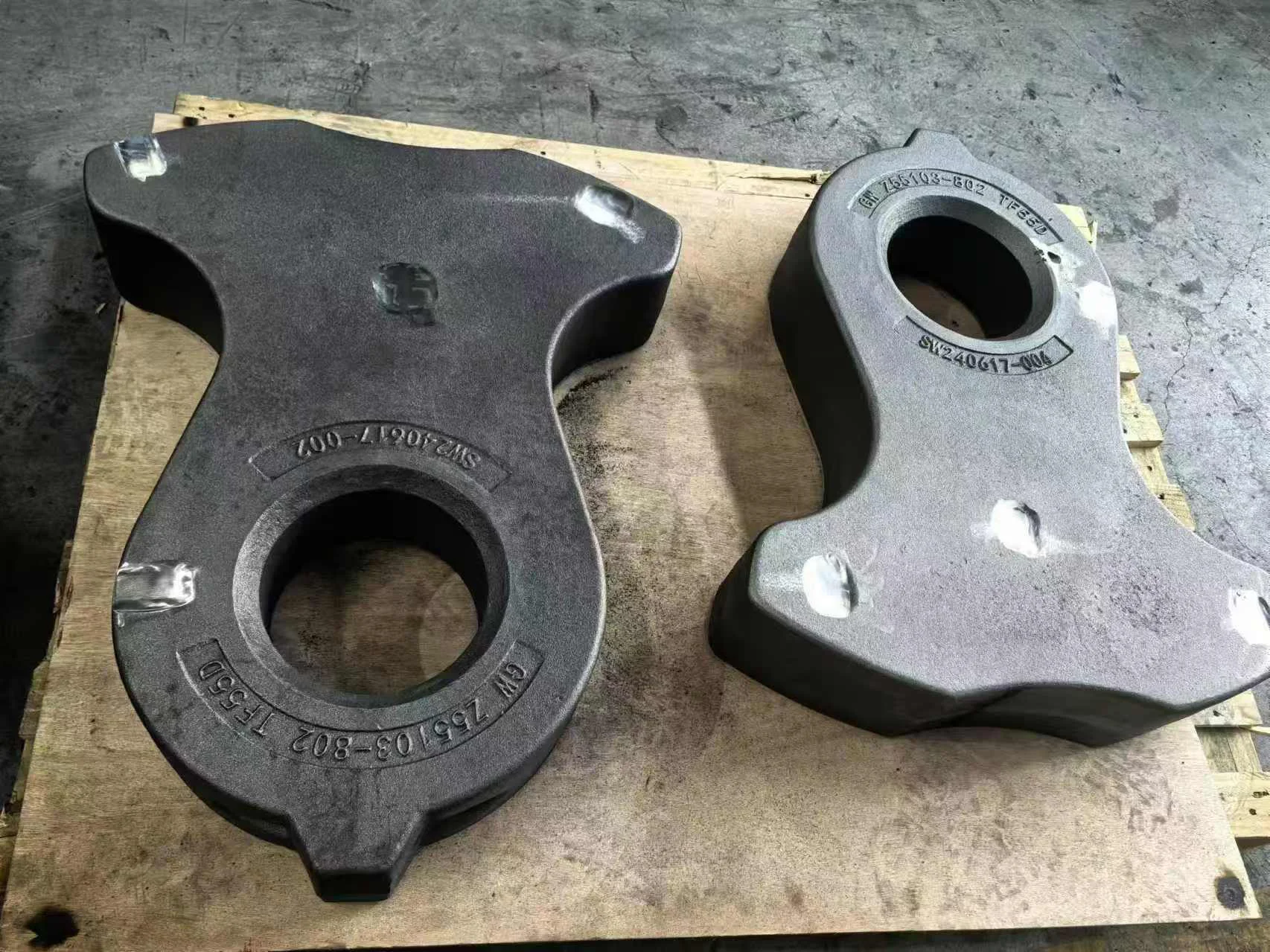
Pin bore wear in shredder hammers is the hidden limit. The shredder hammers may retain usable striking geometry while the pin bore has enlarged, ovalized, or developed step ridges. Once wear has reached the pin bore, the shredder hammers can no longer articulate correctly on the pin, and the group must be scrapped. Shredder hammers with a worn bore will eventually fail at the mounting point, where the consequences extend beyond the hammer itself to the pin, the rotor disc, and the shaft.
Early cap and end wear on shredder hammers reflects a different failure mode: loss of the protective cap or end geometry before the main body has consumed its wear allowance. This pattern often points to a material-grade mismatch or to operating conditions outside the intended duty of the shredder hammers, rather than to normal wear progression.
Measured Replacement Rules: Turn Wear Checks into Decisions
A replacement schedule that relies only on “looks worn” will either discard usable hammers or run spent hammers past the point of efficient shredding. The following condition-based triggers convert inspection observations into actionable decisions.
| Trigger | Condition for Replacement | Rationale |
| Striking edge geometry | Working face has developed an excessive radius; no flat striking reference remains on any face | Loss of edge profile eliminates tearing efficiency |
| Pin bore condition | Visible step ridges, ovalization, or wear reaching the bore | Bore wear prevents correct articulation; scrap the group |
| Cracking or chipping | Crack extending into the working section; chipped striking edge | Stress concentrator with propagation risk under impact |
| Mass loss (per hammer) | Individual hammer mass loss sufficient to produce noticeable rotor vibration | Vibration indicates imbalance; continued operation loads bearings and shaft |
| Throughput and power response | Sustained drop in tons per hour at unchanged feed and grate settings; rising power draw per ton | Hammer no longer transmits energy efficiently into the material |
The mass-loss trigger deserves emphasis because it is often the first measurable sign that a hammer has moved outside its functional envelope. Significant mass loss on an individual hammer disrupts rotor balance and produces heavy machine vibration. At that point, the question is no longer whether to replace that hammer, but whether the set has reached a condition where matched replacement is the safer and more economical path.
Rotation, Flipping, and Matched Replacement
The replacement decision is not binary. Many hammers can be rotated or flipped to expose a fresh wearing surface before full replacement is required. If a flat striking reference remains on an unworn face, flip the hammer; if wear has reached the pin bore, scrap the entire group. On some hammer designs, the available wearing edges are finite: triangular hammers can be rotated twice after the first edge dulls, then flipped over and rotated again for a total of six edges, while J-hammers can be flipped once for a total of two edges. Rotation is therefore a scheduling tool that can align hammer changeouts with planned downtime rather than forcing an unplanned stop.
Rotation does not, however, eliminate the need for matched replacement. When hammers are replaced, they should be installed in matched pairs or balanced sets symmetrically about the rotor centerline, not as random single units. Replacing only some hammers causes the rotor shaft to become unbalanced, and the resulting vibration accelerates wear on bearings, discs, and the remaining hammers. The practical rule is that a hammer replacement event should be planned as a rotor-balance event: either the full set, or a symmetric matched group, with the rotor returned to balance before production resumes.
The Decision Framework: Cost per Ton, Not Unit Price
The most reliable way to decide when shredder hammers need to be replaced is to stop evaluating the decision on part price and start evaluating it on cost per ton produced. A low-cost hammer that requires replacement twice as often, with each changeout consuming several hours of lost production, can be more expensive than a higher-priced hammer that runs longer and holds its striking geometry. The cost-per-ton model is replacement frequency × (downtime + labor) + part cost, divided by tons produced. When that number is tracked across hammer sets, the replacement interval ceases to be an opinion and becomes a measured outcome.
At the inspection level, the decision reduces to three questions. Does the hammer retain usable striking geometry on any face? If yes, rotate or flip. Has wear reached the pin bore, or has cracking entered the working section? If yes, replace the group, not the individual hammer. Is rotor vibration increasing, or is throughput falling at unchanged settings? If yes, the hammer set has moved past its functional limit regardless of remaining thickness, and replacement should be scheduled at the next planned stop rather than deferred to failure.
Shredder hammers do not need to be replaced on a calendar. They need to be replaced when the measurable condition of the working face, the pin bore, and the rotor balance shows that the hammer can no longer transmit energy into the material efficiently. An operator who inspects for those conditions, tracks weight and throughput, and replaces in balanced sets will capture more useful wear from every hammer, protect the rotor from unnecessary imbalance, and keep the shredder producing at the rate its design intended.
About Saikuang Casting
Saikuang Casting is a leading manufacturer of premium-quality Shredder Hammers, operating a 60-acre production facility with an annual capacity of 16,000 tons. We specialize in ceramic and alloy steel castings for the mining, aggregate, and recycling industries.
Our product range includes parts for Metso Barmac B Series, Sandvik CV Series, Trio TV Series, Terex Canica Series, and other popular VSI platforms–. All parts are manufactured and warrantied by Saikuang and are not manufactured, purchased, or warrantied by the OEM.
Contact Saikuang Casting to discuss your Shredder Hammers requirements, request a quote, or explore our upgraded material solutions for extended wear life.
Your Reliable Partner for Crusher Spare Parts
Email: infosk@skpremiumcasting.com
Tel: 0086-17351780508