
Crusher Wear Parts Replacement Schedule
Crusher wear parts are consumable engineering inputs, not reactive inventory. The difference between a maintenance program and a repair program lies in whether replacement timing is planned around measurable wear data or forced by failure. A worn mantle that finally cracks at 2:47 a.m. does not announce itself with a warning light—it announces itself with lost production, collateral damage, and emergency procurement costs. This guide outlines how to build a replacement schedule that captures maximum utilization from every crusher wear parts while protecting the crusher from secondary damage.
Why a Fixed Calendar Schedule Fails
Wear rate is not a function of time. It is a function of feed material, crusher configuration, and operating practice. A manganese liner processing clean limestone may deliver 2,000 hours of service; the same liner in river gravel with high silica content may reach end-of-life in 250 to 450 hours. A schedule based on “every six months” will either discard usable liners prematurely or run worn liners past the point of efficient crushing. The reliable alternative is a schedule built on consumed weight and throughput tonnage, reviewed at fixed inspection intervals.
Signals That Trigger a Replacement Review
The following conditions indicate that crusher wear parts have reached or are approaching their functional limit. Any one of them warrants an inspection and a decision on changeout timing.
Reduced throughput is often the first warning. A consistent drop in tons per hour under unchanged feed conditions signals that the chamber profile has changed and the crusher can no longer grip, crush, and discharge efficiently. A decline of 10% to 15% from the baseline established with new liners is a practical trigger for changeout, even if the liner has not reached its absolute wear limit.
Degraded product gradation appears as oversize material, a rightward shift in the product-size curve, increased recirculating load, or a product shape that becomes flaky rather than cubical. These symptoms indicate that the crushing surfaces have lost the profile needed to control particle breakage.
Increased power draw means the crusher is working harder to achieve the same output. A sustained rise in motor amperage under comparable conditions reflects an inefficient chamber shape or restricted discharge area. Frequent current spikes near the alarm threshold indicate that the liners are deformed and no longer transmitting crushing force efficiently.
Unusual noise or excessive vibration should never be treated as normal. Knocking, grinding, or metal-to-metal contact may indicate loose liners, worn retaining hardware, or excessive clearance. Vibration can result from uneven wear, a damaged bearing, or rotor imbalance. Continuing operation under these conditions risks damage to the head, bowl, pitman, or mainframe.
Visible wear, cracks, or loss of adjustment range are direct physical indicators. Deep grooves, localized thinning, rounded jaw teeth, chipped edges, or cracks mean the part is approaching or past its safe service life. When the closed-side setting can no longer be maintained even with the adjustment system at its limit, the crusher wear parts have exceeded its compensation range and must be replaced.
Reference Replacement Intervals by Component and Material
These crusher wear parts replacement intervals reflect field experience across common crusher types and feed conditions. They are intended as starting points for baseline planning rather than fixed rules; actual replacement intervals for crusher wear parts must be adjusted using site-specific wear data.
| Component | Crusher Type | Typical Interval | Key Trigger Condition |
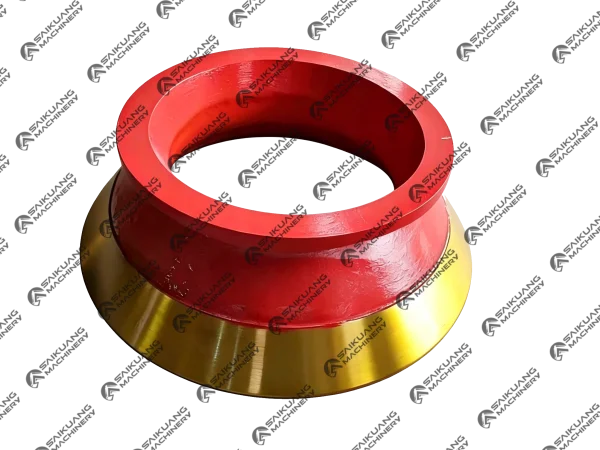
| Mantle liner | Cone crusher | 1500–2500 hours | 25% weight loss or liner float |
| Concave liner | Cone crusher | 2000–3500 hours | Profile deviation >15 mm |
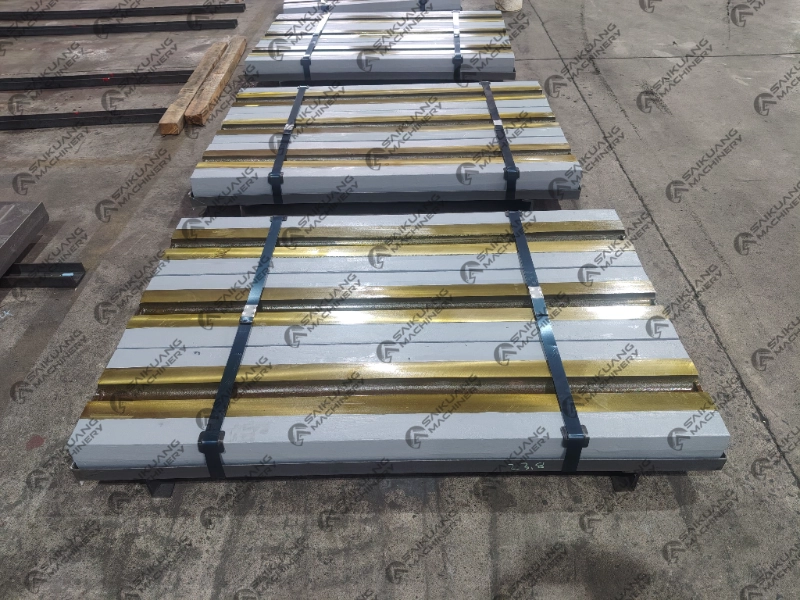
| Jaw plate | Jaw crusher | 400–600 hours (quartzite, 100 mm CSS) | 20–25% original weight loss |
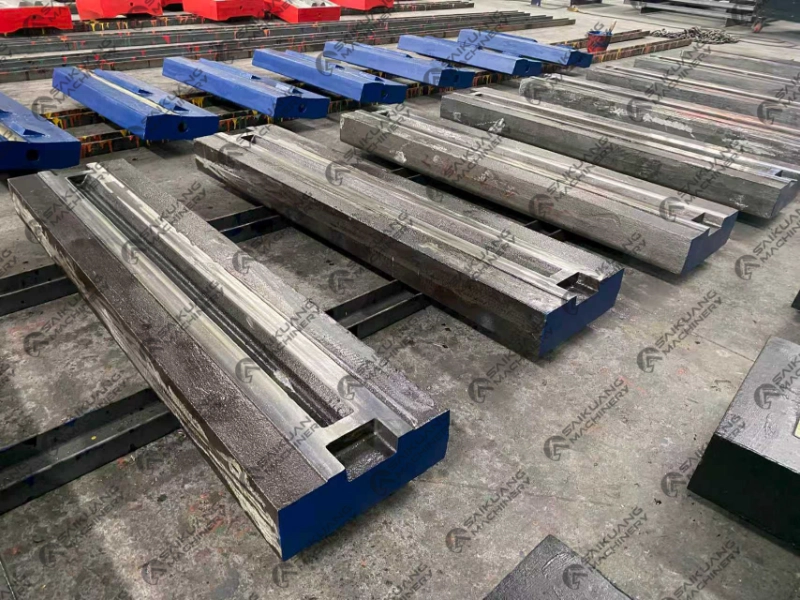
| Blow bars | Impact crusher | 800–1200 hours (limestone, high-chrome) | Leading-edge recession >35 mm |
| Concave segments | gyratory crusher | 1500–3000 hours | Segment thickness loss >60%, step/gap between segments >10 mm, visible cracks, or profile deviation >15 mm |
Building the Schedule: Utilization Targets and Measurement
The objective of a crusher wear parts replacement schedule is neither to run a part until it fails nor to replace it at the first sign of wear. Rather, the goal is to capture at least 50% utilization of each crusher wear part—measured by weight consumed—while maintaining throughput. Typical operations achieve as little as 35% utilization; the remainder is discarded as unusable thickness that no longer contributes to crushing efficiency.
A practical schedule rests on three data inputs:
-
Weight tracking. Weigh liners when new and at each changeout. The target is to run the worn liner to no more than half of its installation weight before replacement. Intermediate weighing at 250-hour intervals establishes the wear rate in kilograms per thousand tonnes processed.
-
Throughput monitoring. Record tons per hour against the baseline established with a new wear set. When throughput falls by 10%, the economic case for continued operation disappears: the lost production value exceeds any residual utilization remaining in the liner.
-
Thickness and profile measurement. For cone crushers, ultrasonic thickness mapping at fixed reference points detects wear patterns before failure. A replacement trigger at 60% thickness loss provides a planned window for changeout rather than an emergency stop. For jaw and impact crushers, physical measurement of jaw die thickness or blow bar edge recession serves the same function.
Operational Factors That Alter the Schedule
Several operating practices shift wear rates in predictable ways and must be reflected in the replacement schedule. Choke feeding maintains rock-on-rock crushing and distributes wear evenly across the mantle; operations without choke feeding experience 40% faster wear concentration. Closed-side setting reductions below manufacturer recommendations increase compression cycles: each 1 mm reduction in CSS decreases liner life by 8% to 12% in granite applications. Feed moisture above 8% increases packing pressure and abnormal concave stress; pre-drying can reduce abrasive wear by approximately 18%. Tramp metal incidents cause immediate, unpredictable damage; magnetic separators and metal detectors reduce such events by up to 90%.
From Schedule to Practice
A crusher wear parts replacement schedule is a living document, not a wall chart. It begins with manufacturer baseline recommendations, is refined by weight and throughput data from the first few liner sets, and is adjusted as feed conditions or operating targets change. The most effective programs treat each changeout as a data point: record the hours, the tonnage processed, the weight consumed, and the wear pattern observed. Over three to five cycles, these records transform replacement timing from an estimate into an engineered decision—one that protects the crusher, stabilizes production, and captures the full value embedded in every wear part.
Contact Us
If you are sourcing reliable aftermarket crusher wear parts, contact us for your quotation. Our technical team can offer professional support to match your crusher and working conditions.
Your Reliable Partner for Crusher wear parts
Email: infosk@skpremiumcasting.com
Tel: 0086-17351780508