
What are Gyratory Crusher Concave Segments
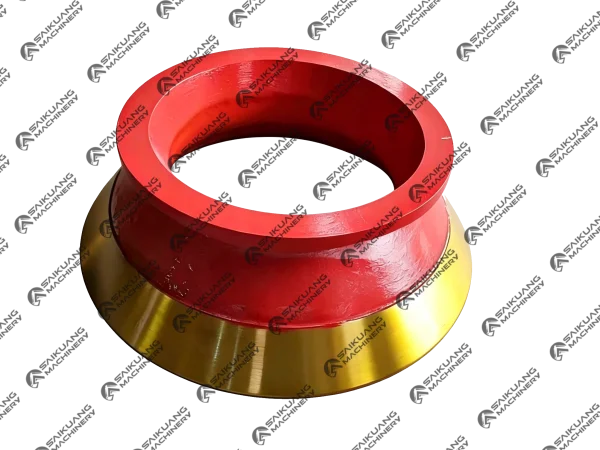
A gyratory crusher reduces rock between two surfaces: the mantle, which gyrates on the main shaft, and the concave, which is fixed inside the upper shell. The concave set wraps the chamber in two, three, or more horizontal rows, depending on crusher size. The top row sits at the feed opening; the lower rows form the narrowing throat where final sizing occurs before discharge.
Segmentation exists for three practical reasons:
Handling and installation. A single-piece concave ring for a primary gyratory would be a multi-tonne casting with no practical lifting or seating path. Segments are individually manageable with the crusher’s standard lifting provisions.
Row-by-row replacement. A worn top row can be changed without pulling the entire concave set. Because the upper intake takes the most violent impact per tonne in many circuits, this row often wears out ahead of the lower tiers—and segmented construction lets the operator retire only the consumed row.
Tier-specific material assignment. Each row wears for a different reason. The upper row absorbs impact; the mid row blends impact and abrasion; the bottom row is dominated by sliding abrasion. Segmentation is what allows a foundry to cast different alloys into different tiers rather than forcing one compromise grade across the whole chamber.
For the buyer, the implication is direct: concave segment procurement is a tier-by-tier material decision, not a single-part purchase.
The Three Wear Zones and What Governs Material Choice in Each
The crushing chamber is not uniform. Forces at the feed opening are not the forces at the discharge. The table below summarizes the dominant failure mode and the material logic for each tier.
| Tier | Position | Dominant wear mechanism | Material logic |
| Upper intake | Feed opening | Impact—large lumps and occasional tramp metal strike the liner at high energy | Toughness first. The alloy must absorb shock without cracking or spalling, while still offering reasonable wear resistance |
| Mid chamber | Transition zone | Mixed impact and abrasion—rock is partly reduced, partly still blocky | Balanced grade. Mn18Cr2 is the conventional workhorse here: enough toughness for residual impact, enough work-hardening for abrasive rock |
| Bottom / discharge | Final sizing throat | Sliding abrasion—rock is fine, velocities are high, impact is low | Abrasion resistance first. High-chromium iron or ceramic-reinforced manganese delivers the surface hardness that pure manganese cannot sustain in this zone |
This is the same zoning logic that appears across the industry, and it is technically sound. SAIKUANG’s position is not to dispute it but to execute it at the casting and machining level: the value a manufacturer adds is in delivering a Mn18Cr2 mid-tier segment and a high-chrome bottom-tier segment that actually fit the same chamber, seat against the same shell, and hold their joint clearances through thermal cycling.
SAIKUANG’s Material Range for Gyratory Crusher Concave Segments
SAIKUANG is a manganese steel, alloy steel, high-chromium iron, and ceramic-composite casting manufacturer, For Gyratory Crusher Concave Segments, the relevant grades are:
Mn18Cr2:As-cast hardness of approximately 200–240 HB, work-hardening to 500+ HB under crushing load. This is the standard grade for most primary gyratory concave applications and the default specification for mid-tier segments. It offers the best balance of toughness and work-hardening capacity in the manganese family.
Mn22Cr2 / Mn22Cr3:As-cast hardness of 210–250 HB, work-hardening to 520–550+ HB. The premium manganese option for hard, abrasive ores where maximum work-hardening is required. Field data indicates 1.3–2× the wear life of Mn18Cr2 on hard abrasive feed in suitable applications.
High-chromium iron (Cr20 / Cr26 type). Surface hardness in the HRC 58–62 range after heat treatment. High-chrome is the technically appropriate choice for bottom-tier segments where wear is pure sliding abrasion and impact is low. Its abrasion resistance per unit volume exceeds what any austenitic manganese grade can deliver in that specific loading condition.
Ceramic-reinforced alloy / TiC-enhanced manganese. Hard ceramic particles distributed in a tougher matrix. This is SAIKUANG’s upgrade path for operators who need abrasion resistance beyond high-chrome without accepting the fracture risk of a fully brittle liner in the lower chamber. Ceramic-composite wear parts are a core part of SAIKUANG’s casting programme, alongside conventional manganese and chrome grades.
The metallurgy of gyratory crusher concave segments is well established: manganese for toughness and work-hardening, high-chrome for pure abrasion, composites for the overlap zone. The manufacturing challenge is consistency—hitting the specified chemistry, hardness, and soundness in every segment of every set—not inventing a new alloy category.
Core Advantages of SAIKUANG Gyratory Crusher Concave Segments
1. Tier-Specific Material Assignment
SAIKUANG casts gyratory crusher concave segments in Mn18Cr2, Mn22Cr2, high-chromium iron, and ceramic-reinforced grades, and can supply a set with different alloys in different tiers. The upper intake, mid chamber, and bottom discharge can each receive the grade that matches its wear mechanism, rather than a single compromise alloy across the full set.
2. Casting Consistency, Verified per Heat
Chemistry and hardness are checked on each production heat. The segment you receive is the grade specified on the order—not a “close enough” manganese heat that will work-harden below expectation.
3. Dimensional Control on Seating and Joint Faces
Seating faces, joint faces, and mounting interfaces are machined to the drawing envelope. This is the manufacturing discipline that allows segments to seat flat, butt cleanly, and hold chamber geometry through the liner cycle.
4. Segment-Level Supply, Not Just Full Sets
SAIKUANG supplies individual tiers and individual segments, not only complete concave sets. Operators planning a row-by-row replacement programme can order the specific tier that is due for change without committing to a full set.
5. Direct Manufacturer Economics
SAIKUANG produces gyratory crusher concave segments as a direct manufacturer. The pricing structure reflects foundry economics rather than distributor margins—without a trade-off in chemistry verification or dimensional control.
Gyratory Crusher Concave Segments Brands and Platforms Supported
SAIKUANG Gyratory Crusher Concave Segments are manufactured to fit the major primary gyratory platforms. Brand and model references are used for identification purposes only; all parts are manufactured and warranted by SAIKUANG.
| OEM Platform | Typical Application |
| Metso Superior / MK-II series | Primary gyratory, mining and large quarry |
| Sandvik CG series | Primary gyratory, hard rock |
| FLSmidth Fuller-Traylor | Primary gyratory, high-capacity mining |
| ThyssenKrupp KB series | Primary gyratory |
| Kawasaki / EarthTechnica | Primary gyratory |
Fitment is confirmed against the crusher model, cavity type, and tier configuration before casting. Where original drawings or patterns are not available, SAIKUANG can work from installed dimensions and segment samples to establish a matched replacement.
Contact Us
If you are sourcing reliable aftermarket Gyratory Crusher Concave Segments or other crusher spare parts, contact us for your quotation. Our technical team can offer professional support to match your crusher and working conditions.
Your Reliable Partner for Crusher Spare Parts
Email: infosk@skpremiumcasting.com
Tel: 0086-17351780508